
Cladding Durability Guide for Steel Buildings

Most cladding problems start small: a loose screw, a worn washer, salt on the bottom panels, or a chipped finish. If I stay on top of those early, steel cladding can last 50–60+ years.
Here’s the plain answer: panel life depends on the whole system, not just the steel sheet. I look at coating type, paint finish, fasteners, site exposure, installation, and cleaning schedule. I also keep one thing clear: a warranty is not the same as service life.
If I want cladding to last in Canadian conditions, I focus on:
- Fasteners first: even 10 loose screws on a 9 × 15 m (30 × 50 ft) roof can create many leak points
- Lower wall panels: the bottom 30–45 cm (12–18 in.) usually get hit hardest by road salt, slush, and mud
- Finish condition: once paint or coating fails, moisture and UV start wearing the panel down
- Site exposure: coastal, industrial, and farm buildings need closer checks than inland sites
- Twice-yearly inspections: spring and fall are the main times I check cladding, seals, and gutters
- Fast repairs: scratches, backed-out screws, bad sealant, and rust spots should be fixed right away
A few parts need more attention than the flat middle of a panel:
- Cut edges
- Joints and laps
- Fastener heads and washers
- Trim and penetrations
- Base panels near grade
My bottom line: cladding lasts longer when I match the panel system to the site, inspect it on schedule, and repair small faults before they spread.
| What I check | Why it matters |
|---|---|
| Coating and finish | Slows rust, fading, chalking, and surface wear |
| Fasteners and washers | Common source of leaks and panel movement |
| Lower wall panels | First area to catch salt spray and splash-back |
| Seals, laps, penetrations | Weak points for water entry |
| Cleaning and records | Helps with upkeep, claims, and insurance files or when requesting steel building prices |
The rest of this guide breaks down what shortens cladding life, what materials and finishes tend to hold up better, and what maintenance steps matter most in Canada.
Metal Cladding: The 70-Year Facade for Buildings
sbb-itb-747b4cf
Cladding Materials and Finish Systems That Last
Cladding life comes down to three layers: the base metal, the metallic coating, and the paint finish.
That sounds simple enough. But the weak spots usually aren’t in the middle of a clean panel. Trouble tends to start at cut edges, joints, and fasteners. That’s where corrosion often shows up first. And even a good panel system can fall short if the site conditions or installation details are off.
Steel Base Metals and Metallic Coatings
Prefinished steel cladding usually uses metallic coating systems such as hot-dip galvanized steel and Galvalume/Aluzinc.
How long they last depends on two things:
- the type of coating
- how well that coating stays in place over time
In Canadian conditions, maintenance matters more than looks. Keep panels clean and fix damage quickly. Appearance comes second. Scratches and chips should be repaired as soon as possible, with extra care at edges, joints, and fasteners.
Paint Finishes: Standard Polyester vs. PVDF
The two main finish options are standard polyester and PVDF.
The key point is simple: the finish has to stay intact. Its job is to block UV and moisture. Once that finish breaks down, the panel starts losing that protection. It’s a bit like a rain jacket with a tear in the sleeve – it may still look fine from a distance, but water gets in where it counts.
Start inspections with fasteners and trim. That’s where debris and moisture tend to build up first. And in harsher Canadian exposures, conditions can shift fast.
Climate, Building Use, and Exposure Conditions in Canada
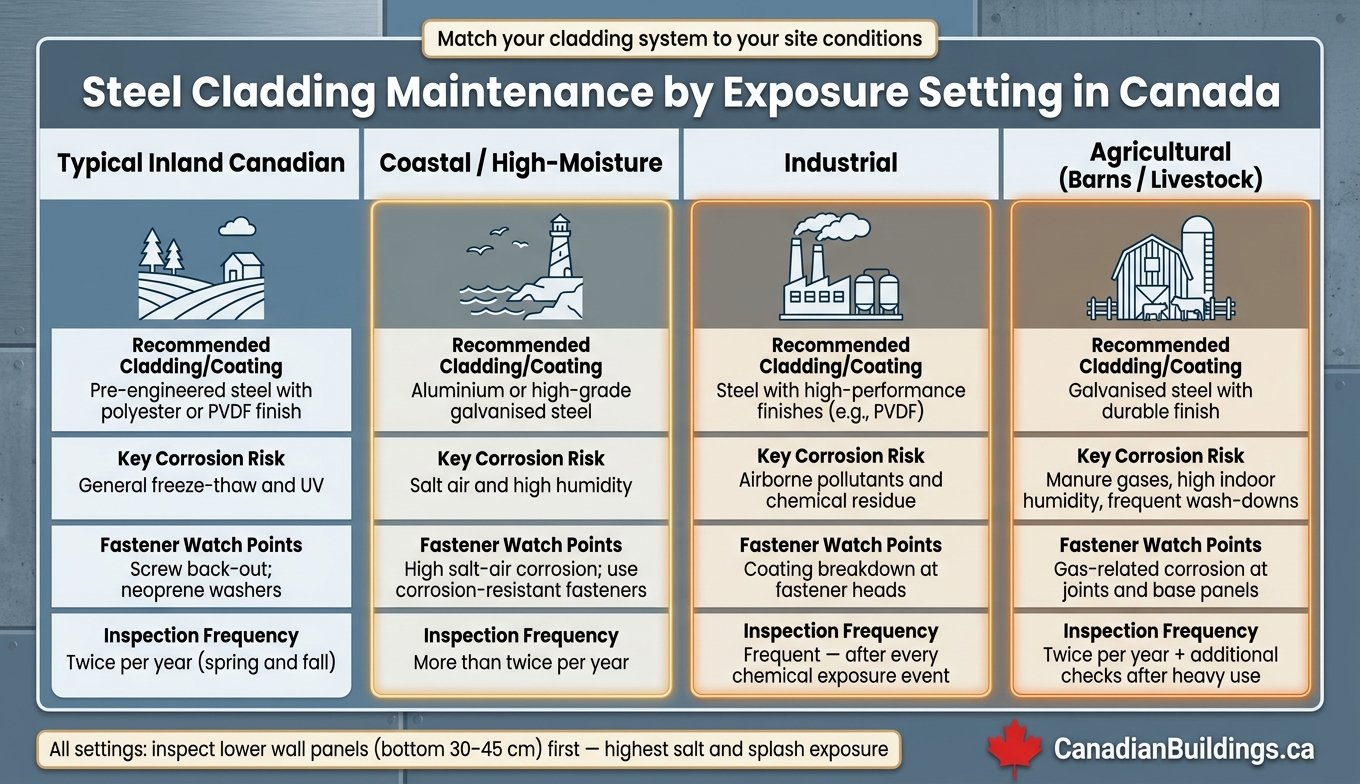
Steel Cladding Maintenance by Exposure Setting in Canada
Even tough finishes wear out faster when exposure gets rough. And in Canada, steel cladding deals with a lot: freeze-thaw cycles, heavy snow, road salt, and sharp temperature swings. If the cladding system doesn’t fit the site, those conditions can put stress on panels, joints, and fasteners in a hurry.
Canadian Climate Stresses That Shorten Cladding Life
The coating matters, but the site often decides how long that coating holds up. As metal expands and contracts again and again, fasteners can loosen and small gaps can open at joints and seals. Heavy snow adds load to roof panels, while meltwater can slip through weak seals or poorly performing joints.
Road salt is another big problem. Splash from de-icing salt hits the lower wall panels the hardest, especially the bottom 300–450 mm (12–18 inches) of cladding. Sun exposure also wears finishes down over time. Once bare steel is exposed, corrosion can move fast. Then there’s condensation inside the wall assembly. That kind of hidden moisture can rust steel from the inside out long before anyone spots damage on the surface.
Higher-Risk Settings: Coastal, Industrial, and Agricultural
Some buildings have a much harder life than others. Inland sites usually face less corrosion pressure than coastal, industrial, or farm settings. Near the coast or in high-moisture areas, salt air and damp conditions push corrosion risk higher. Industrial sites add airborne pollutants and chemical residue. Agricultural buildings – like barns, livestock shelters, and storage buildings – face manure gases, high indoor humidity, and frequent wash-downs.
Agricultural buildings need closer watch in particular. Those conditions can speed up failure in both coatings and fasteners, so inspections need to happen more often and repairs can’t wait.
Use the table below to match exposure, material, and inspection frequency.
| Exposure Setting | Recommended Cladding/Coating | Fastener Considerations | Inspection Frequency |
|---|---|---|---|
| Typical inland Canadian | Pre-engineered steel with polyester or PVDF finish | Check for screw back-out twice yearly; inspect neoprene washers | Twice per year (spring and fall) |
| Coastal/High-Moisture | Aluminium or high-grade galvanised steel | High salt-air corrosion risk; use corrosion-resistant, compatible fasteners | More frequent than twice per year |
| Industrial | Steel with high-performance finishes such as PVDF | Inspect frequently for coating breakdown at fastener heads | Frequent checks after chemical exposure |
| Agricultural (Barns/Livestock) | Galvanised steel with a durable finish | Monitor for gas-related corrosion at joints and base panels | Twice per year; additional checks after heavy use periods |
Fasteners, Detailing, and Installation
Cladding only holds up when the fasteners, seals, and details fit both the panel and the site. A small failure at a screw or seal can cut service life faster than damage to the panel itself. Once climate and exposure are known, fastening and detailing do a lot of the work in keeping the system watertight.
Matching Fasteners to the Cladding and Environment
Fastener back-out is the most common cladding maintenance issue. Check exposed fasteners after the spring thaw, and replace loose screws or backed-out fasteners with early rust discoloration right away. During routine inspections, replace cracked or flattened neoprene washers too.
That said, fastener checks alone won’t stop leaks at joints and openings.
Installation Details That Prevent Early Failure
Steel cladding seams, joints, and openings need enough room for panel movement so seams aren’t put under stress during thermal change and wind loads. Check sealant around vents, conduits, and rooftop units, since these are common leak points where failed sealant can let in water and pests. Detail doors, louvers, and penetrations tightly to cut down on leaks and upkeep.
Start cleaning with the lower wall panels, where salt and grime tend to build up. After that, inspect sealant joints, panel edges, and wall penetrations before the damage spreads.
Cleaning, Inspection, Repair Planning, and Key Takeaways
Once the cladding is installed, regular maintenance keeps small defects from turning into leaks or corrosion.
Cleaning and Inspection Schedule for Canadian Conditions
Inspect cladding in spring and fall, and book one professional inspection each year. Pay close attention to the bottom 30–45 cm (12–18 inches) of wall panels, where road salt, slush, and grime tend to build up fastest.
For cleaning, use a low-pressure rinse on base panels after winter and after muddy conditions. Skip high-pressure washing. It can damage coatings or push water into panel laps and joints.
| Task | Suggested Frequency | Problems Prevented |
|---|---|---|
| Low-pressure rinse (base panels) | Spring – annually | Corrosion from road salt and winter grime |
| Detailed walk-through of fasteners, seals, panel edges | Spring and Fall | Leaks, rust, and loose fasteners |
| Gutter and downspout cleaning | Spring and Fall | Water pooling and foundation damage |
| Sealant and joint check | Fall – before winter | Water infiltration and freeze-thaw damage |
| Coating touch-up (scratches, chips) | Upon discovery | Rapid oxidation of exposed bare steel |
| Professional inspection | Annually | Warranty and insurance documentation |
That yearly professional inspection also helps with warranty and insurance records.
Each inspection should do two things: handle routine cleaning and spot damage that needs fast repair. That split matters. A bit of dirt is one thing. A failed seal or exposed steel is another.
When to Repair, Recoat, or Replace Panels
Fix loose fasteners, scratches, and sealant gaps as soon as you spot them. Focus on the trouble areas that tend to fail first: fasteners, sealant, panel edges, and lower wall panels. If paint starts bubbling or flaking over rust, deal with it right away. Clean back to sound metal, then recoat before the corrosion spreads. Touch-up paint on chips and scratches should be applied promptly so bare steel doesn’t start to oxidize.
Some signs point to a bigger issue. Replace panels that rattle, bow, sit out of line, or show rust that keeps spreading. Interior water stains or damp insulation are also warning signs that a local seal failure has turned into a broader problem.
Large recoating jobs or panel replacement often need access equipment and can interrupt operations. In plain terms, the bill usually climbs once damage spreads. Early touch-ups often cost less than waiting.
Build repair costs into the annual maintenance plan.
Regular cleaning, inspection, and prompt repair extend cladding life.
FAQs
How long should steel cladding last in Canada?
In Canada, a well-built, properly maintained steel building can last 50 to 100+ years. In many cases, the main steel frame makes it through that full span. The outer cladding and related parts usually don’t last as long, so they need checks, upkeep, and occasional replacement along the way.
How long the building holds up depends on local wear and tear, especially road salt, freeze-thaw cycles, heavy snow loads, and moisture control. That’s why biannual inspections matter. Small issues like paint chips or surface scratches may seem minor, but fixing them early can help stop rust and other damage from getting worse.
Which cladding finish lasts the longest?
PVDF coatings, such as Kynar 500, are among the longest-lasting cladding finishes. They typically resist fading and chemical breakdown for 30 to 40 years.
In areas with high moisture or salt exposure, Galvalume is often a better pick than standard galvanized steel because it offers stronger corrosion resistance. Silicone-modified polyester tends to come with shorter warranties, usually around 25 to 30 years.
That said, no finish is bulletproof. If scratches or chips expose the surface, early failure can happen much sooner than expected.
When should cladding be repaired or replaced?
Repair cladding as soon as issues show up. Waiting can turn a small fix into a much bigger, more expensive problem.
Treat surface rust, bubbling paint, or flaking paint within two weeks of spotting it. For scratches and chips, act right away and use a zinc-rich primer to help stop corrosion before it spreads.
Fasteners should be replaced if you notice:
- pitting
- loss of strength
- stripped holes
- flat, cracked, or brittle EPDM washers
Bent columns need immediate attention from a qualified professional. It also makes sense to schedule a professional engineering review every 5 to 10 years, or after major storm damage.